The Presence Lab Podcast · Episode 300
What to Say When Your Team Asks If AI Will Take Their Jobs
A leader can’t promise anyone their future. A leader can promise the chair beside them.
The question is showing up in one-on-ones, hallways, parking lots and kitchen-table conversations: “Is AI going to take my job?” The usual advice to embrace AI may be useful career advice. It does not answer the fear underneath the question.
The fear isn’t asking for advice. It’s asking for company.
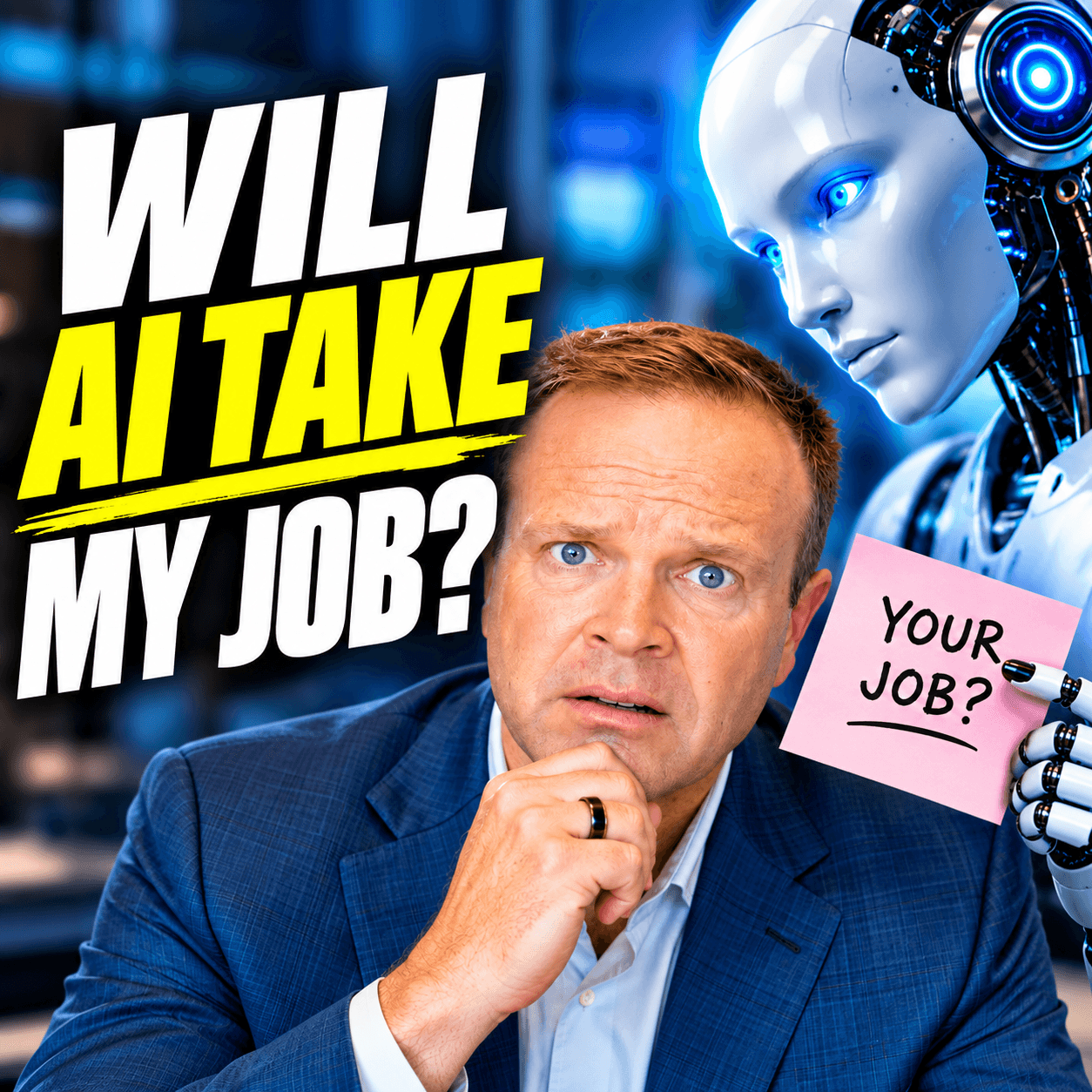
Listen or Watch Episode 300
What should a leader say when an employee asks if AI will take their job?
Don’t promise that the job is safe. Move shoulder to shoulder with the person: share what AI is changing in your own work, give facts instead of forecasts, and focus together on what they can control.
When an employee asks whether AI will take their job, the instinct is to reassure them or give advice. Both can miss the actual problem. The leader cannot reliably predict what happens next. What the leader can provide is honesty, care, involvement and a sense of control.
“The fear isn’t asking for advice, it’s asking for company.”
Why are employees so worried about AI and job security?
Because the question is everywhere, and the signals people see are loud while practical guidance for leaders is scarce.
- Gallup reported in September 2026 (opens in a new tab) that 27% of U.S. workers worried technology could soon make their job obsolete, a record high in its polling.
- Challenger, Gray & Christmas reported (opens in a new tab) that companies cited AI in more than 100,000 announced job cuts during 2026 through August.
- Dale’s own Media Cloud research found more than 2,000 national U.S. news story placements connecting AI with job loss, layoffs or job fear during a three-month period, while only a handful addressed what leaders should actually say to employees.
Why “embrace AI and you’ll be fine” doesn’t solve the problem
Learning AI tools may be smart career advice, but it answers a different question than the one being asked.
Gallup’s July 2026 data found AI non-users were over-represented among people who had been laid off. But that does not mean using AI makes the fear disappear.
Gallup reported in September (opens in a new tab) that workers using AI daily or several times a week reported acute displacement fear at more than twice the rate of infrequent users.
“The people who already embraced it are the most worried.”
The advice may be useful. It simply answers a different question. The employee is asking about uncertainty, not merely skill development.
Why does AI job uncertainty create so much stress?
Uncertainty itself can create stress because the brain has to remain alert for an outcome it cannot predict.
In a University College London study (opens in a new tab) led by Archy de Berker, participants played a computer game in which virtual rocks might hide snakes, and a snake resulted in a mild electric shock. Stress measurements peaked when the odds were 50/50. Stress was lower when participants knew a shock definitely would or definitely would not occur.
It was one laboratory study involving mild shocks, published in Nature Communications (opens in a new tab), and it should not be stretched too far. Still, it helps explain the experience of someone asking whether their job is safe. They are looking for certainty the leader may not be able to provide.
Research on organizational change by Bordia and colleagues (opens in a new tab) adds a useful distinction. Management communication helped reduce uncertainty about organizational strategy. Job-related uncertainty was affected differently. Participation in decisions increased people’s sense of control, and control was associated with lower psychological strain.
Gallup (opens in a new tab) found that workers who strongly felt their organization cared about their wellbeing and respected them reported lower displacement fear.
More prediction is not the answer. Care, respect, involvement and some sense of control matter.
Move from across the desk to shoulder to shoulder
After a recent keynote, someone asked Dale, “How do I start hard conversations?”
Rather than answering from behind the lectern, Dale pulled a chair next to the person and answered from there.
Across the desk
The leader looks like the person delivering a verdict.
Shoulder to shoulder
The problem sits in front of both people.
“Shoulder to shoulder, the fog feels smaller.”
Three moves for the AI job-security conversation
Go first. Stick to facts. Then turn together toward what can be controlled.
1Go first
Before answering anything about the employee’s future, start with how AI is changing your own work, what you’ve learned, what has surprised you and what you still do not know.
“I get asked this a lot, and I ask it about my own job, too. Here’s how I see AI changing the work I do. Here’s what I know right now, and here’s what I don’t know yet.”
Vulnerability has a boundary. The leader shares honest uncertainty, not personal unraveling.
The leader’s promise: a spirit of no surprises. A leader may not control every company decision. The promise is about the leader’s own behavior: whatever can appropriately be shared will be shared as soon as possible.
2Facts, not forecasts
Never tell someone, “Your job is not at risk,” unless that can actually be known. It is a prediction.
“I can’t tell you what’s going to happen, and I won’t pretend I can. Here’s what I know for a fact today, and here’s what I’ll do the moment I know more.”
“On camera, message discipline protects you. Shoulder to shoulder, it has to protect them.”
3What do you control?
Stephen Covey described three circles. The center holds what we control. The middle holds what we influence. The outer ring holds what concerns us but sits outside our reach.
Control- Control
- 80%
- Influence
- 15%
- Concern
- 5% or less
Dale’s coaching rule of thumb for where to aim attention. It is a practical guideline, not a research finding.
“Let’s look at this together. What part of your work do you control? Where do you have influence? Let’s put our energy there, and let’s figure out how you can help shape what AI does on our team.”
The leader offers the chair. The employee has to sit in it. Employees still have a responsibility to learn, stay current and participate in shaping how AI affects their work.
Care comes first. Responsibility comes as an invitation.
Free Field Guide · Episode 300
Keep This Conversation Next to You
The free Episode 300 Field Guide puts the three moves, circles of control and sample language on one page. Use it to prepare before the AI job-security question lands in the room.
Episode 300: The Person Who Started It
Years ago, Dale was filling in on a radio morning show when Jason Jennings appeared to promote his first book. After the interview, Jason asked to speak with Dale during the commercial break. He complimented Dale for actually reading the book before the interview and told him to stay in touch.
Fourteen years later, while writing Sweating Bullets, Dale saw Jason’s name on his bookshelf and reached out. Jason had written eight bestselling books and did not have a podcast. Dale proposed starting one together.
Jason said yes.
They recorded 238 episodes together before Jason died in May 2020.
“Do the preparation, and take care of the people in front of you.”
Episode 300 returns to one of Jason’s leadership lessons through the story of “Brian,” a leader who had to lay off 30 people during the pandemic and personally stayed in contact with them afterward.
Listen to Jason Jennings on layoffs, Game Changers Episode 234 (opens in a new tab)
Questions leaders are asking about AI and job security
What should I tell an employee who asks if AI will take their job?
Don’t promise the job is safe if that cannot be known. Share what is known, acknowledge what is uncertain, explain what will be communicated as things change, and help the employee focus on what they can control and influence.
Should a manager tell employees their jobs are safe from AI?
Not unless the manager can actually know that. “Your job is safe” is a forecast. A better response separates facts from predictions and promises honest communication rather than an unknowable outcome.
Why are employees worried about AI even when they use AI at work?
Using AI does not necessarily remove uncertainty about what it means for someone’s future. Gallup reported in September 2026 that frequent AI users showed substantially greater displacement fear than infrequent users.
How can leaders reduce AI anxiety at work?
Leaders cannot remove all uncertainty, but research suggests care, respect, participation and a sense of control matter. Give people facts, involve them where possible and help them focus on what they can control and influence.
How should leaders communicate about AI layoffs?
Use facts rather than forecasts, communicate what is known as early as responsibly possible, avoid false reassurance, and treat affected people with care and respect. A “spirit of no surprises” is more credible than promising an outcome the leader cannot control.
What are the three moves for talking to employees about AI job security?
Go first by sharing how AI is affecting your own work. Give facts instead of forecasts. Then ask what the employee controls and where they can influence what happens next.
Research behind this episode
The findings referenced on this page link to their original sources. The 80/15/5 ratio and the Media Cloud count come from Dale’s own coaching and research.
- Workers’ fear of losing jobs to technology (opens in a new tab)
Gallup, September 2026
- AI does not reassure workers. Managers do. (opens in a new tab)
Gallup workplace research, September 2026
- Challenger Report, August job cuts (opens in a new tab)
Challenger, Gray & Christmas, August 2026
- Uncertainty can cause more stress than inevitable pain (opens in a new tab)
University College London
- Computations of uncertainty mediate acute stress responses in humans (opens in a new tab)
de Berker et al., Nature Communications (2016)
- Uncertainty during organizational change (opens in a new tab)
Bordia et al., Journal of Business and Psychology (2004)
- Research by Gibson, Harari & Marr (opens in a new tab)
Organizational Behavior and Human Decision Processes, ScienceDirect
- AI is probably not yet the reason the labor market is weakening (opens in a new tab)
Yale Budget Lab
- Working paper by Bick, Blandin & Deming (opens in a new tab)
National Bureau of Economic Research
- Wayne Cascio on downsizing and layoffs (opens in a new tab)
University of Colorado Denver Business School
- The labor market for recent college graduates (opens in a new tab)
Federal Reserve Bank of New York
Know a Leader Who Is About to Get This Question?
Think of one manager or friend who leads a team and is likely to hear, “Is AI going to take my job?” Send them this episode.
Practice the Conversations Before They Matter
The Presence Lab is a free community for leaders working on communication under pressure. We meet for live Q&A and practical application, so the next hard conversation is one we’ve already rehearsed.