The Presence Lab Podcast · Season 5, Episode 301
Next Move
What to do the night before a high-stakes meeting when your mind keeps rehearsing everything that could go wrong.
The meeting is tomorrow. You know the material. And your brain keeps running the same scene: the question you can’t answer, the skeptical board member, the opening that falls flat, the moment it all goes sideways.
The bad forecast isn’t the problem. The unfinished forecast is.
Listen or Watch Episode 301
The front porch
My daughter had a speaking part in a school Shakespeare play. Several weeks out, she told me she was nervous.
I asked what exactly she was nervous about. She said, “I don’t know. I’m just scared.” She practiced, but quietly. So I moved farther away. Then to the end of the hall while she stood at the opposite end of the house. Louder, but still not there.
So we went outside. She stood on the front porch, and I crossed the street into the neighbor’s yard. She found this embarrassing. She had to say her lines loudly enough that they bounced off the neighbor’s front door and came back to her. And we practiced the ending too, the whole speech, start to finish.
I didn’t tell my daughter to calm down, and I didn’t tell her to picture the applause. We kept practicing in the days before the play. Then she said this:
“Dad, I feel so much better about this. I know my lines, and I know I can say them in a way that the entire audience can hear.”
She didn’t describe feeling calm, and she didn’t predict a great night. She described a response she could count on. “I’m just scared” is what a forecast sounds like before anyone has finished it. The porch gave it an ending.
Why does your mind race before a high-stakes meeting?
Because your mind is rehearsing the meeting, and the imagined meeting triggers a real physical response.
You picture the tough question, and your jaw tightens. You picture the silence after your answer, and your breathing gets shallow. Nothing has happened yet, but your body is already reacting as if it has.
The trouble starts when the mental movie freezes at the worst moment. If the scene always stops at the objection, the silence or the “no,” your attention stays parked on the alarm. Your body rehearses the alarm instead of rehearsing what you will do next.
Nervousness on its own is survivable. It gets much easier to carry when your attention has somewhere to go. That idea has support: Jones, Fazio and Vasey (2012) found that attentional control moderates the link between anxiety and performance.
Should you visualize success before an important meeting?
Picturing it going well is fine. Stopping there is the problem, because it leaves you with no plan for the moment that doesn’t go well.
The common advice is to swap the bad movie for a good one: picture the handshake, you’ve got this. But the goal isn’t a better movie. The goal is a movie that reaches the end.
“The fix isn’t a better prediction, it’s a finished rehearsal.”
Astronaut Chris Hadfield is a useful example. On April 22, 2001, during STS-100, he made the first spacewalk by a Canadian. Partway through, anti-fog cleaner got into his eye. The tears had nowhere to go in zero gravity. They pooled and crossed to his other eye. He vented oxygen, worked with his partner Scott Parazynski, and finished the work.
In his 2014 TED talk, Hadfield described practicing things going wrong, underwater and in simulators, again and again. In his book, he cautions against visualizing victory and stopping there. The preparation wasn’t assuming nothing would go wrong. It was already knowing what to do when something did.
The research points in a similar direction. Brown and Stopa (2007) found that self-rated performance was better after anticipation. Norem and Cantor (1986) reported that reassurance impaired the performance of defensive pessimists, people who prepare by thinking through what could go wrong. We’re citing that finding from a secondary source, so treat it as suggestive rather than settled.
What is the NEXT MOVE method?
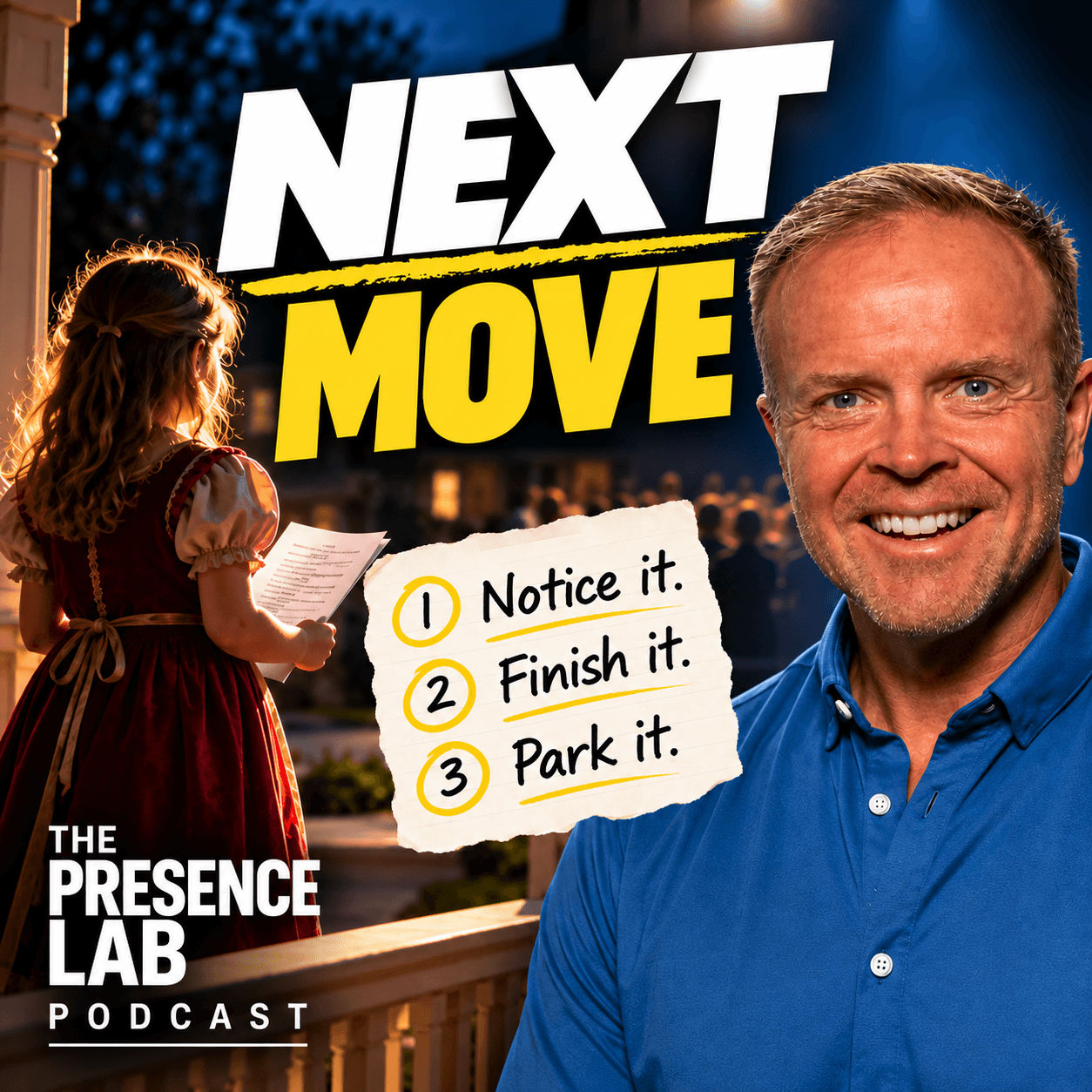
NEXT MOVE is a three-part method for finishing an anxious mental rehearsal: notice the forecast, finish it with your response, then park it.
Notice it
A body signal is the cue that a forecast is running.
A clenched jaw on the pillow. A shallow breath at a red light. An argument in the shower with someone who isn’t there. When you catch it, take one slow breath and ask yourself which part you’ve been rehearsing: theirs, or yours.
Finish it
Run the forecast all the way to the end, then add one line.
Let the scene play past the worst moment. Then say, out loud and start to finish, the way it will sound in the room: “If that happens, my next move is this.”
Park it
One forecast. One next move. Written down. Done.
If the same worry shows up again at 3 a.m., it doesn’t get a fresh debate. It gets the answer you already wrote.
The answer doesn’t need to be brilliant. It needs to be available.
How should you prepare the night before a high-stakes meeting?
Rehearse your part, not theirs. Then decide what you will do if the moment you fear actually happens.
Have I rehearsed their part, or mine?
Most of us put enormous mental energy into what the other person might do. The board member’s objection. The client’s pushback. The interviewer’s curveball. The investor who frowns at slide six.
That rehearsal prepares them beautifully. The board member is ready. You are not.
The useful rehearsal is the next line after theirs. Two examples from the Field Guide:
- The forecastThe CFO challenges the number.
- My next moveAsk which assumption worries her most, then take that one apart together.
- The forecastSomeone asks a question I can’t answer.
- My next moveSay what I know, name what I still need to find out, give a time I’ll come back.
Then do what my daughter did on the porch. Say your opening and your closing out loud, full voice, start to finish, in the biggest space you can find.
Free Field Guide · Episode 301
Put NEXT MOVE on paper.
The Episode 301 Field Guide turns the idea into a working exercise for your next high-stakes conversation. Identify the forecast that keeps showing up, decide your next move, rehearse it, then park it.
- A NEXT MOVE wall poster
- A self-audit: where does your mental rehearsal usually stop?
- A Forecast / Next Move worksheet
- Body cue log
- The Front Porch rehearsal drill
- The Park Rule
- A seven-day tracker
Questions about preparing for a high-stakes meeting
Why do I get anxious the night before an important meeting?
Because your mind is rehearsing the meeting, and the imagined meeting produces a real physical response. When that mental rehearsal keeps stopping at the worst moment, such as the hard question or the skeptical look, your body rehearses the alarm instead of what you will do next.
How do I stop overthinking a high-stakes meeting?
Finish the thought instead of fighting it. Let the feared scene run to the end, decide “If that happens, my next move is this,” and write that next move down. When the same worry comes back, it gets the answer you already wrote rather than a new round of worry.
Should I visualize success before a presentation or meeting?
Picturing success is fine, but stopping there leaves you unprepared for the moment that goes sideways. The goal is not to replace a bad movie with a good movie. The fix isn’t a better prediction, it’s a finished rehearsal, one that includes what you will do if things go wrong.
What should I rehearse before a difficult meeting?
Rehearse your part, not theirs. Most of us spend hours rehearsing what the board member, client or interviewer might say. The useful rehearsal is your response if the feared moment actually happens, said out loud from start to finish, including your opening and your close.
What is the NEXT MOVE method?
NEXT MOVE is a three-part method from Episode 301 of The Presence Lab for finishing an anxious mental rehearsal. Notice it: treat a body signal as the cue that a forecast is running. Finish it: run the forecast to the end and add “If that happens, my next move is this.” Park it: one forecast, one next move, written down, done.
How can I prepare for a difficult question without obsessing over every possibility?
Give each recurring worry one written answer and stop there. You don’t need a response to every possible question. You need a next move for the forecast that keeps showing up. For a question you can’t answer, the Field Guide example is: say what you know, name what you still need to find out, and give a time you will come back.
Research behind this episode
Much of this research comes from laboratory speech tasks, often with socially anxious participants. It supports the idea; it doesn’t make a promise about any one meeting.
- What I learned from going blind in space (opens in a new tab)
Chris Hadfield, TED (2014)
An Astronaut’s Guide to Life on Earth
Chris Hadfield (2013)
- The spotlight, anticipatory processing and performance (opens in a new tab)
Brown, M., & Stopa, L. (2007). Behavioural and Cognitive Psychotherapy, 35(2), 133-147
- Defensive pessimism: Harnessing anxiety as motivation (opens in a new tab)
Norem, J. K., & Cantor, N. (1986). Journal of Personality and Social Psychology, 51(6), 1208-1217
- Attentional control buffers the effect of public-speaking anxiety on performance (opens in a new tab)
Jones, C. R., Fazio, R. H., & Vasey, M. W. (2012). Social Psychological and Personality Science, 3(5), 556-561
Before you go
Know someone with a big meeting tomorrow?
You probably know one person who is holding tomorrow’s meeting in their head right now, running it for the ninth time tonight. Send them this episode.
Practice the skill underneath the skill
Communicating under pressure is a skill. Staying steady enough to use it is the skill underneath. The Presence Lab is a free community where leaders practice both, with live Q&A and practical application, so the next hard moment already has a next move.